Breaking: Trump Demands Greenland Purchase or Faces 25% European Tariffs in Unprecedented NATO Crisis
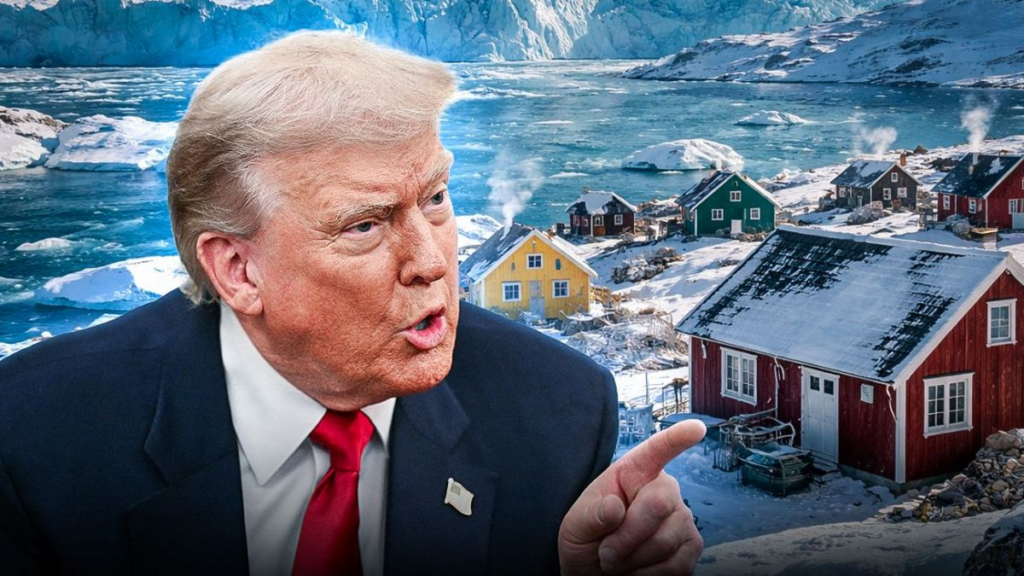
The geopolitical landscape has dramatically shifted as President Donald Trump escalated his demands for Greenland acquisition with an extraordinary ultimatum threatening eight European NATO allies with escalating tariffs. This unprecedented move has sent global financial markets into turmoil and sparked what analysts are calling the most severe transatlantic crisis in generations.
Immediate Market Impact and Economic Fallout
The financial markets reacted with swift and brutal efficiency to Trump’s Saturday announcement. The S&P 500 plunged 2.1%, completely erasing all gains accumulated in 2026 and marking the worst single-day performance since October. The Dow Jones Industrial Average hemorrhaged 875 points, declining 1.77% to close at 48,484 points, while the Nasdaq Composite suffered a 2.39% drop.
| Market Index | Points Lost | Percentage Decline | 2026 Performance |
| S&P 500 | 146 points | -2.1% | -0.7% YTD |
| Dow Jones | 875 points | -1.77% | +0.3% YTD |
| Nasdaq Composite | 567 points | -2.39% | -1.2% YTD |
| VIX (Fear Index) | +4.2 points | +25% | 20.99 level |
The volatility extended beyond equities, with the Cboe Volatility Index—Wall Street’s primary “fear gauge”—spiking to 20.99, its highest reading since November. Long-term U.S. Treasury yields jumped to four-month highs as investors reassessed the safety of American assets, particularly after reports emerged that Denmark’s ATP pension fund is planning to exit U.S. Treasuries entirely.
The Tariff Timeline: A Calculated Escalation Strategy
Trump’s tariff proposal follows a methodical escalation pattern designed to maximize pressure on European governments. According to his Truth Social announcement, eight countries—Denmark, Norway, Sweden, France, Germany, the United Kingdom, the Netherlands, and Finland—will face a 10% tariff on “any and all goods” shipped to the United States beginning February 1, 2026.
The stakes increase dramatically on June 1, when tariffs would jump to 25% if no agreement has been reached for what Trump calls the “Complete and Total purchase of Greenland.” This graduated approach gives European leaders a four-month window to negotiate while watching economic pressure mount systematically.
| Affected Countries | Feb 1 Tariff | June 1 Tariff | Annual Trade Volume (USD) |
| Germany | 10% | 25% | $265 billion |
| United Kingdom | 10% | 25% | $143 billion |
| France | 10% | 25% | $89 billion |
| Denmark | 10% | 25% | $14 billion |
| Netherlands | 10% | 25% | $87 billion |
| Sweden | 10% | 25% | $21 billion |
| Norway | 10% | 25% | $18 billion |
| Finland | 10% | 25% | $8 billion |
Europe’s Response: The “Trade Bazooka” Strategy
European leaders responded with unprecedented unity and determination, with multiple high-ranking officials calling for activation of the Anti-Coercion Instrument (ACI)—a powerful but never-before-deployed economic weapon designed specifically to counter coercion from external states. Bernd Lange, chairman of the European Parliament’s trade committee, publicly demanded immediate activation of this mechanism.
The European Union has entered intensive discussions to implement retaliatory tariffs potentially totaling $108 billion on American products. This figure represents one of the largest coordinated economic responses in European history and signals Brussels’ willingness to engage in a protracted trade war rather than capitulate to Trump’s demands.
European Commission President Ursula von der Leyen and European Council President Antonio Costa issued strongly worded joint statements warning that “tariffs would undermine transatlantic relations and risk a dangerous downward spiral.” They emphasized Europe’s commitment to “remain united, coordinated, and committed to upholding sovereignty.”
The Nobel Prize Connection: An Unusual Diplomatic Twist
In an extraordinary revelation, Trump linked his aggressive Greenland stance directly to his failure to receive the Nobel Peace Prize. In a message to Norwegian Prime Minister Jonas Gahr Store obtained by Bloomberg, Trump wrote: “Considering your Country decided not to give me the Nobel Peace Prize for having stopped 8 Wars PLUS, I no longer feel an obligation to think purely of Peace.”
This unprecedented mixing of international diplomacy with personal grievances has stunned diplomatic circles and raised questions about the president’s decision-making process in matters of global security and economic policy.
Strategic Importance of Greenland
The Arctic island’s strategic value cannot be overstated in the current geopolitical environment. Greenland occupies a critical position between the Arctic and North Atlantic oceans, providing the shortest air and sea routes between North America and Europe. The territory houses crucial U.S. military installations, including early-warning systems that monitor the Greenland-Iceland-UK gap—a critical choke point for naval operations.
Beyond military considerations, Greenland possesses vast deposits of rare-earth minerals essential for advanced technology manufacturing, including smartphones, electric vehicles, and fighter aircraft. As climate change opens new Arctic shipping lanes, control of Greenland becomes increasingly valuable for both commercial and strategic purposes.
Legal Challenges and Supreme Court Implications
The legality of Trump’s tariff threats faces immediate scrutiny, as they would likely rely on the International Emergency Economic Powers Act (IEEPA)—the same legal framework the Supreme Court is currently reviewing in relation to Trump’s earlier tariff implementations. Trade attorneys suggest that if the Court rules against the administration’s use of emergency powers for tariff imposition, Trump’s Greenland-related threats would collapse.
However, the administration maintains alternative legal pathways, particularly Section 232 of the Trade Expansion Act of 1962, which allows tariffs based on national security concerns related to critical minerals—of which Greenland possesses abundant reserves.
Global Economic Implications
The ramifications extend far beyond the immediately affected countries. Major European automakers saw significant stock declines, with Volkswagen, Stellantis, and BMW all experiencing share price drops exceeding 3% in Monday trading. Technology companies heavily reliant on transatlantic supply chains also suffered, with semiconductor manufacturers particularly vulnerable to disruption.
Currency markets reflected the uncertainty, with the U.S. dollar declining against most major currencies despite traditionally benefiting from geopolitical tensions. This unusual pattern suggests deep concern among currency traders about America’s standing as a reliable trading partner and the potential for European liquidation of dollar-denominated assets.
Davos Summit: High-Stakes Diplomacy
President Trump’s scheduled meetings at the World Economic Forum in Davos, Switzerland, have taken on critical importance. European leaders plan to confront Trump directly about his Greenland ambitions, with multiple bilateral meetings scheduled. French President Emmanuel Macron has already stated firmly that “no intimidation nor threat will influence us,” while German officials work on coordinated response strategies with EU partners.
The summit represents possibly the last opportunity for diplomatic resolution before the February 1 tariff implementation deadline, though Trump’s public statements suggest little willingness to back down from his demands.