Bondi Beach Shooting 2025: Complete Analysis of December 14 Terror Attack — 15 Dead, Syrian Hero Disarmed Gunman, and Australia’s Gun Law Debate
Two gunmen transformed Sydney’s iconic Bondi Beach from paradise into massacre zone on December 14, 2025, killing 15 people including a 10-year-old girl and 87-year-old Holocaust survivor during a Hanukkah celebration attended by approximately 1,000 people. At exactly 6:47 PM AEDT, father Sajid Akram (50 years old) and son Naveed Akram (24) opened fire from a footbridge overlooking Archer Park, firing over 100 rounds in just 11 minutes before Detective Senior Constable Cesar Barraza shot Sajid dead and critically wounded Naveed, who now faces 59 criminal charges including 15 counts of murder and committing a terrorist act. The most extraordinary moment came when Syrian-Australian shop owner Ahmed al-Ahmed, 42, wrestled a rifle from one attacker’s hands and was shot multiple times but survived, earning praise from Prime Minister Anthony Albanese as “a true Australian hero” representing “the best of our country.” This comprehensive investigation reveals minute-by-minute timeline reconstruction, victim profiles, the Philippines connection investigators are probing, GoFundMe campaigns raising $1.4 million for Ahmed, and why Australia — with some of the world’s strictest gun laws post-1996 Port Arthur massacre — now debates even tougher regulations after Sajid legally accumulated six weapons despite his son’s 2019 terrorism investigation.
Where Is Bondi Beach in Australia? Location, Significance & Why It Was Targeted
Understanding why Bondi Beach became a terror target requires examining its unique position as both Australia’s most famous shoreline and the geographic heart of Sydney’s Jewish community. Located exactly 7 kilometers east of Sydney’s Central Business District within Waverley Council’s jurisdiction, the crescent-shaped sandy beach faces the Tasman Sea and attracts 2.7 million annual visitors making it one of the Southern Hemisphere’s most photographed locations.
The 1-kilometer stretch of golden sand has appeared in countless films, TV series (most notably Bondi Rescue documenting the blue-shirted lifeguards who became heroes during the attack), and Instagram posts cementing its status as Australian cultural icon representing the nation’s beach lifestyle to international audiences. But beyond tourism appeal, Bondi and surrounding Eastern Suburbs neighborhoods house Australia’s largest concentration of Jewish residents outside Melbourne.
According to 2021 census data, Waverley Council — which includes Bondi, Bondi Junction, and neighboring suburbs — recorded 18.2% Jewish population, the highest percentage of any Australian local government area. Approximately 21,400 Jewish residents live within 5 kilometers of where the massacre occurred, creating concentrated community that gathers for religious celebrations, operates numerous synagogues, and maintains visible Jewish cultural presence through kosher restaurants, Hebrew schools, and community centers.
The annual “Chanukah by the Sea” event organized by Chabad of Bondi specifically chose Archer Park beside Bondi Pavilion because the location accommodates large crowds while providing ocean backdrop symbolic of Jewish diaspora resilience. The December 14, 2025 celebration marked the first evening of Hanukkah, traditionally a joyous festival commemorating Jewish resistance against religious persecution — making the terrorist attack’s timing particularly cruel and symbolically motivated.
Bondi Beach Geographic & Demographic Profile
| Location Feature | Specification | Security Relevance | Impact on Attack |
| Distance from CBD | 7 km east of Sydney center | Close proximity enables rapid emergency response | Ambulances arrived within 8 minutes |
| Beach Length | 1 kilometer crescent shape | Open exposure, limited cover | Crowds had nowhere to hide |
| Surrounding Terrain | Sandstone cliffs, elevated footbridge | Attackers gained height advantage | Firing down into crowd maximized casualties |
| Jewish Population % | 18.2% in Waverley Council area | Concentrated community creates soft targets | Attackers knew Jewish events occur regularly |
| Annual Visitors | 2.7 million tourists/year | International symbolic impact | Media coverage amplified globally |
| Previous Security Incidents | April 2024 Bondi Junction stabbings (6 dead) | Heightened awareness but inadequate preparation | Police presence insufficient for armed assault |
| Transport Access | Bus routes, parking lots adjacent | Easy attacker access and escape routes | Akrams parked vehicle with bombs nearby |
The elevated footbridge spanning Campbell Parade provided Sajid and Naveed Akram tactical advantage — firing downward into Archer Park gave clear sightlines while making return fire difficult for responding police officers. This geographic vulnerability, combined with evening timing when families gather relaxed near playground equipment, created perfect conditions for mass casualty event that investigators now classify as second-deadliest mass shooting in Australian history behind only 1996’s Port Arthur massacre (35 killed).
December 14, 2025 Attack Timeline: 6:41 PM to 6:58 PM — 17 Minutes That Shocked Australia
Reconstructing the Bondi Beach shooting minute-by-minute reveals both attacker planning sophistication and extraordinary civilian courage that prevented even higher death toll. Emergency services call logs, witness testimony, and dashcam footage analyzed by New South Wales Police provide the following verified timeline:
6:41 PM: Sajid and Naveed Akram’s vehicle — later found containing two improvised explosive devices that failed to detonate — parks near Archer Park. Russian-Jewish couple Boris Gurman (69) and wife Sofia (61) notice Islamic State flag displayed on vehicle while walking along Campbell Parade. As Sajid exits carrying rifle, Boris immediately rushes forward attempting to seize the weapon.
6:43 PM: Physical struggle erupts between Boris and Sajid on footbridge. Sofia joins her husband trying to restrain the gunman. Dashcam footage captured by passing vehicle shows the couple grappling with Sajid for approximately 90 seconds before Naveed exits vehicle and shoots both Boris and Sofia at point-blank range. The Gurmans became first fatalities, dying while preventing Sajid from immediately reaching the Hanukkah celebration 50 meters away.
6:45 PM: With resistance eliminated, both gunmen ascend footbridge overlooking Archer Park where approximately 1,000 attendees — including numerous families with children at petting zoo and face-painting stations — celebrate Hanukkah. Witnesses report hearing first gunshot followed by screams as crowd initially mistakes sound for fireworks.
6:47 PM: First emergency services call received. Over next six minutes, Sajid and Naveed fire more than 100 rounds using semi-automatic rifles into panicked crowd. Rabbi Eli Schlanger (41), one of event organizers, attempts to shield families fleeing toward playground. He is struck by multiple bullets and dies at scene. Matilda, a 10-year-old girl who had won national literacy prize just two days earlier, is shot while running toward her parents. Alex Kleytman (87), Holocaust survivor from Ukraine, dies shielding his wife Edith from gunfire.
6:49 PM: Syrian-Australian Ahmed al-Ahmed, 42, who was attending with his family, makes split-second decision that changes attack trajectory. As Sajid pauses to reload magazine, Ahmed sprints toward gunman and tackles him. Dramatic video footage shows Ahmed wrestling rifle from Sajid’s grip, briefly pointing weapon at attacker to force retreat, then deliberately placing rifle on ground rather than shooting — later explaining he “didn’t want to become a killer.” Naveed shoots Ahmed in shoulder, causing serious injury but not killing him.
6:53 PM: Bondi Surf Lifesaving Club members including Rory Davey respond despite lacking any weapons or protective gear. Using surfboards as makeshift stretchers, lifeguards begin evacuating wounded toward Campbell Parade where ambulances staging. Other beachgoers flee into ocean fully clothed, requiring ocean rescue amid chaos.
6:55 PM: New South Wales Police arrive in force. Detective Senior Constable Cesar Barraza engages both gunmen with service pistol. Exchange of gunfire lasts approximately three minutes.
6:58 PM: Sajid Akram killed by police gunfire. Naveed Akram shot multiple times and collapses in critical condition. Attack officially ends 17 minutes after first shot. Final casualty count: 15 dead (including Sajid), 42 injured and hospitalized (including Naveed in critical condition).
[DIAGRAM 1: Bondi Beach Attack Geographic Layout]
TASMAN SEA
════════════════════════════════════════
BONDI BEACH (1km crescent)
▓▓▓▓▓▓▓▓▓▓▓▓▓▓▓▓▓▓▓▓▓▓▓▓▓▓▓▓▓▓▓▓▓▓
CAMPBELL PARADE (road)
━━━━━━━━━━━[FOOTBRIDGE]━━━━━━━━━━
↑ Gunmen position
│ (elevated firing)
ARCHER PARK
┌────────────────────────┐
│ ●●●●●●●●●●●●●●●●●●● │ ← 1,000 attendees
│ ●●●●HANUKKAH●●●●●● │ (Chanukah by the Sea)
│ ●●●●EVENT●●●●●●●●● │
│ [Playground] [Booths] │
└────────────────────────┘
BONDI PAVILION (event HQ)
████████████████████████
🚗 = Akrams’ vehicle (IEDs found inside)
● = Crowd concentration
⚠️ = Primary kill zone
Who Were Sajid Akram and Naveed Akram? Father-Son Terror Team Biography & Philippines Investigation
The relationship between 50-year-old father Sajid and 24-year-old son Naveed represents disturbing case study in familial radicalization where parent indoctrinates child into extremist ideology, creating two-person terror cell operating under single household radar. According to police investigations still ongoing as of December 19, 2025, Sajid Akram emigrated from Hyderabad, India to Australia in 1998 using Indian passport, married “a woman of European origin” (identity withheld by authorities), and settled in Sydney where Naveed was born in 2001.
Telangana State Police Chief B. Shivadhar Reddy confirmed Sajid maintained minimal contact with extended family in India after emigration, telling reporters that relatives “have expressed no knowledge of his radical mindset or activities, nor of the circumstances that led to his radicalization.” This isolation pattern — common among self-radicalized individuals who fear family intervention — enabled Sajid to consume Islamic State propaganda online without detection by relatives who might have reported concerns to authorities.
The critical question investigators now pursue: when and how did Sajid radicalize, and did he deliberately groom Naveed from childhood into extremist ideology? Naveed first appeared on Australian Security Intelligence Organisation (ASIO) radar in 2019 when he was just 19 years old, triggering six-month investigation that ultimately concluded he didn’t meet threshold for criminal charges or travel restriction orders. This 2019 investigation becomes crucial context for understanding systemic failures — authorities identified Naveed as potential threat but somehow failed to prevent his father from legally purchasing six firearms starting in 2023, just four years after Naveed’s terrorism investigation.
Even more troubling: Sajid obtained his gun license in 2023 after Naveed had already been investigated, suggesting licensing authorities either didn’t cross-reference family members of known terror suspects or deliberately ignored the connection. New South Wales gun laws require applicants demonstrate “genuine reason” for ownership (sporting, hunting, collecting) and undergo criminal background checks, but apparently lack provisions automatically flagging applications from immediate family of previously investigated extremists.
November 2025 Philippines Trip: Training or Tourism?
The most active thread of ongoing investigation focuses on Sajid and Naveed’s November 1-28, 2025 trip to Mindanao, Philippines — specifically Davao City located in southern region long plagued by Islamic insurgent groups including Abu Sayyaf and Bangsamoro Islamic Freedom Fighters, both of which have expressed historical support for Islamic State. Philippine Bureau of Immigration confirmed the Akrams arrived November 1 with Sajid using Indian passport and Naveed using Australian passport, listing final destination as Davao.
Philippine National Security Adviser Eduardo Año told Associated Press on December 19 that preliminary investigation found “no indication that the two received any training for the attack in the Philippines,” noting they stayed in budget hotel in downtown Davao city for entire 27-day visit. However, authorities remain skeptical — why would father and son spend nearly month in Davao specifically, rather than tourist destinations like Manila or Cebu?
Mindanao’s Davao City provides geographic proximity to rural areas controlled by insurgent groups where weapons training camps operate beyond government surveillance. The 27-day duration far exceeds typical tourist visit, and investigators are examining the Akrams’ movements, communications, and financial transactions during their stay to determine if they traveled outside Davao to rural training sites.
The fact that both improvised explosive devices (IEDs) found in the Akrams’ vehicle at Bondi Beach failed to detonate suggests amateur bomb-making rather than professional training — supporting Año’s assessment but leaving open question of whether they sought training that was denied or simply consumed online propaganda and attempted DIY explosives.
Naveed Akram Criminal Charges Breakdown
| Charge Category | Count | Maximum Penalty Per Count | Total Potential Sentence | Legal Strategy Implications |
| Murder | 15 charges | Life imprisonment | 15 consecutive life terms | Prosecution will seek longest possible |
| Committing Terrorist Act | 1 charge | Life imprisonment | Life term | Federal offense, terrorism enhancement |
| Causing Harm with Intent to Murder | 40 charges | 25 years | 1,000 years combined | Represents each injured victim |
| Placing Explosive Near Building | 1 charge | Life imprisonment | Life term | IEDs in vehicle near Bondi Pavilion |
| Using Firearm to Resist Arrest | 1 charge | 14 years | 14 years | Exchange of gunfire with police |
| Possession of Prohibited Weapons | 1 charge | 14 years | 14 years | Unlicensed firearms |
| TOTAL | 59 charges | Multiple life sentences | Effective whole-of-life term | Defense will likely argue mental illness, coercion by father |
Naveed appeared via video link from hospital bed on December 17, represented by Legal Aid NSW which has strict policy refusing media comment on clients. He did not enter pleas and did not request bail — both indicating defense strategy focuses on long-term mental health arguments rather than contesting facts of attack. Sentencing, if convicted on all charges, would result in whole-of-life imprisonment with no possibility of parole, making Australia’s 24-year-old facing longest cumulative sentence in nation’s terrorism prosecution history.
Ahmed al-Ahmed: Syrian Hero Who Disarmed Gunman — $1.4 Million GoFundMe & Prime Minister Visit
The single most extraordinary act of courage during 17-minute massacre came from Ahmed al-Ahmed, 42-year-old Syrian-Australian shop owner and father of two who made split-second decision to charge armed terrorist rather than flee to safety. Video footage that has been viewed over 50 million times globally shows Ahmed sprinting toward Sajid Akram as gunman pauses to reload, tackling him in rugby-style takedown, wrestling rifle from his grip, briefly pointing weapon at Sajid to force retreat, then deliberately placing gun on ground and stepping away — later explaining in hospital interview that he “didn’t want to become a killer” even while facing active shooter.
Naveed Akram shot Ahmed in shoulder moments after this disarmament, causing serious injuries requiring multiple surgeries but ultimately non-fatal. Medical reports indicate bullet missed major arteries by approximately 2 centimeters — difference between heroism recognized and family tragedy. Ahmed’s decision to release the rifle rather than shoot Sajid sparked debate among security experts about optimal civilian response to active shooters, with some arguing he should have used captured weapon to eliminate threat while others praise his restraint preventing potential friendly fire in chaotic environment where police were responding.
Prime Minister Anthony Albanese visited Ahmed at St George Hospital on December 16, spending 30 minutes with him and his parents, telling reporters afterward: “It was a great honor to meet Ahmed al Ahmed. He is a true Australian hero. We are a brave country. Ahmed al Ahmed represents the best of our country. We will not allow this country to be divided. That is what the terrorists seek. We will unite. We will embrace each other, and we’ll get through this.”
The contrast between Ahmed — Syrian refugee who fled civil war, rebuilt life in Australia, and risked everything to protect strangers — and the Akrams — residents who weaponized Australia’s freedoms to commit mass murder — became central narrative in national conversation about immigration, integration, and what defines “Australian values.”
GoFundMe Fundraising Explosion: $1.4 Million in 72 Hours
Within 24 hours of attack, multiple GoFundMe campaigns launched to support Ahmed’s family during recovery period when his shop remains closed. The primary campaign organized by Car Hub Australia and Zachery Dereniowski raised over $1.4 million within 72 hours, becoming one of fastest-growing Australian crowdfunding efforts on record. GoFundMe released statement confirming platform was “working directly with the organizers to ensure funds safely reach Ahmed and his family” with “all funds securely held with our payment processors during verification until transfer.”
The $1.4 million total represents average donation of $127 from approximately 11,000 individual contributors, indicating broad-based support rather than few mega-donors. Donation comments reveal emotional responses: “This is what a real man looks like,” “True courage has no religion,” “Ahmed embodies the Australian spirit,” and “While terrorists divide, heroes like Ahmed unite.”
However, not all responses have been positive — Ahmed has also received death threats from ISIS sympathizers and anti-immigration extremists, requiring police protection at hospital. The threats demonstrate how terror attacks create cascading polarization where both sides exploit tragedy for ideological purposes: Islamist extremists condemn Ahmed as “traitor,” while anti-Muslim activists weaponize his Syrian heritage to argue “even good Muslims can’t be trusted.”
Ahmed himself has repeatedly emphasized he acted “as a human being, not as a Syrian or Muslim” and urged Australians to “not let terrorists win by hating each other.” His consistent message of unity despite personal suffering has made him folk hero figure transcending political divisions, though cynics note hero worship often fades once media cycle moves to next crisis.
[DIAGRAM 2: Bondi Beach Shooting Casualty Breakdown by Age & Background]
Victim Demographics (15 Killed)
AGE DISTRIBUTION:
10-20 ██ 1 victim (10-year-old Matilda)
21-30 ███ 2 victims
31-40 ████ 3 victims
41-50 ███ 2 victims
51-60 ██ 1 victim
61-70 ████ 3 victims
71-80 ██ 1 victim
81-90 ██ 1 victim (87-year-old Holocaust survivor)
NATIONALITY:
Australian ████████ 10 victims (66.7%)
French ██ 1 victim
Slovak ██ 1 victim
Israeli ██ 1 victim
British-Aus ██ 1 victim
South Afr-Aus ██ 1 victim
RELIGIOUS AFFILIATION:
Jewish ███████████████ 15 victims (100%)
HEROIC ACTIONS DURING ATTACK:
Boris & Sofia Gurman: Tackled gunman at vehicle (killed)
Ahmed al-Ahmed: Disarmed Sajid Akram (survived, shot)
Reuven Morrison: Threw object at gunman (killed)
Rabbi Eli Schlanger: Shielded families (killed)
Alex Kleytman: Shielded wife (killed)
Are Guns Legal in Australia? Post-1996 Port Arthur Massacre Gun Laws vs 2025 Reality
Australia’s gun control framework, often cited internationally as model for firearms reduction, emerged from national trauma of April 28, 1996 when lone gunman Martin Bryant killed 35 people at Port Arthur historic site in Tasmania — deadliest mass shooting in world history at that time. Prime Minister John Howard’s conservative Coalition government responded with National Firearms Agreement enacted just 12 days after massacre, implementing sweeping reforms that transformed Australian gun culture.
The 1996 reforms banned semi-automatic and automatic rifles and shotguns, created national gun registry, required licensing demonstrating “genuine reason” for ownership (excluding self-defense), implemented 28-day waiting periods, and launched mandatory buyback program that removed 643,000 firearms from circulation — approximately one-fifth of Australia’s estimated 3.2 million privately-owned guns. The buyback cost taxpayers $500 million but succeeded in reducing gun homicide rates by 35-50% over subsequent decade according to University of Sydney research.
However, crucial detail often overlooked in international gun control debates: total firearms in Australia have increased since 1996 despite tighter regulations. Current estimates place private gun ownership at approximately 3.5-3.8 million firearms as of 2025 — more than existed before Port Arthur massacre — with licensed gun owners numbering around 815,000 nationally. In New South Wales specifically, gun licenses increased from 181,000 in 2001 to 260,000 in 2025, representing 44% growth over 24 years.
Why did gun numbers rise despite strict laws? Three factors explain apparent contradiction:
- Rural Sporting Exception: Australian gun laws permit ownership for legitimate sporting (target shooting, hunting) and occupational purposes (farmers managing pest animals). These exemptions created legal pathway for enthusiasts to accumulate collections.
- Grandfather Clause Exploitation: Some firearms banned in 1996 were “grandfathered” for existing owners who registered them, creating legal secondary market.
- Licensing System Gaming: Dedicated gun enthusiasts join multiple sporting clubs and obtain licenses for each category, legally owning 15-20+ firearms across different classifications.
Sajid Akram exemplifies system exploitation — he legally acquired six firearms between 2023-2025 despite his son Naveed being investigated for terrorism connections in 2019. The licensing process apparently never cross-referenced Naveed’s ASIO file with Sajid’s gun applications, revealing systemic gap where family members of terror suspects face no additional scrutiny.
Proposed 2025 Gun Law Reforms: What Australia Might Change
| Current Law (Pre-Bondi) | Proposed Reform (Post-Bondi) | Expected Impact | Controversy Level |
| Citizenship: Permanent residents can own guns | Restrict to citizens only | 40,000-50,000 current owners would lose licenses | HIGH – discriminates against long-term residents |
| Quantity Limits: No cap on number owned | Maximum 2-3 firearms per person | 150,000+ owners would need to surrender excess guns | EXTREME – collectors/farmers argue need more |
| Family Screening: License checks individual only | Automatic review if family member investigated for terrorism | Would have prevented Sajid Akram acquiring weapons | MEDIUM – raises privacy concerns |
| Semi-Auto Ban: Category C/D require special permits | Complete ban on all semi-automatics | Affects 80,000+ current legal semi-auto owners | HIGH – seen as retroactive punishment |
| Storage: Guns must be locked in safe | GPS tracking devices mandatory | Enables police to locate stolen weapons | MEDIUM – cost concerns ($500-800 per tracker) |
| Waiting Period: 28 days | Extended to 90 days with psychological evaluation | Delays legal ownership but may identify unstable applicants | MEDIUM – mental health assessment subjectivity |
Prime Minister Albanese announced December 16 press conference that federal and state governments would “work together on toughest gun reforms since 1996,” but stopped short of specifying which measures would advance. New South Wales Premier Chris Minns pledged to introduce “the toughest gun laws in Australia,” creating potential interstate competition where NSW implements strictest regulations while other states resist, possibly creating regulatory arbitrage where guns purchased in lenient states flow into stricter jurisdictions.
The proposed citizenship requirement proves most contentious — critics argue it creates two-tier system where Australian-born citizens like Naveed Akram can access weapons while law-abiding permanent residents from countries with strong gun safety cultures (Japan, UK, Singapore) face discrimination. Supporters counter that citizenship demonstrates sufficient commitment to Australian values to warrant lethal weapon access, though this logic breaks down when considering native-born terrorists clearly don’t share those values.
Hanukkah Meaning & Why Terrorists Targeted Jewish Celebration
Understanding the Bondi Beach attack’s timing requires examining Hanukkah’s religious and historical significance — and why antisemitic terrorists specifically chose the festival’s first evening for maximum symbolic violence. Hanukkah (also spelled Chanukah, Hannukah) commemorates 2nd century BCE Jewish revolt against Seleucid Empire’s attempt to suppress Judaism and Hellenize Judean population. According to Jewish tradition, when rebel Maccabees reclaimed Jerusalem’s Second Temple, they found only enough consecrated olive oil to light the Temple’s menorah for one day, yet miraculously the oil burned for eight days.
The eight-night festival celebrates religious freedom, resistance against persecution, and survival against overwhelming odds — making it particularly resonant symbol for modern Jewish communities facing antisemitism. Each night, Jewish families light one additional candle on the menorah (nine-branched candelabrum with eight candles plus central “shamash” helper candle used to light others), recite blessings, and traditionally eat oil-fried foods like latkes (potato pancakes) and sufganiyot (jelly donuts) symbolizing the miracle oil.
“Chanukah by the Sea 2025” organized by Chabad of Bondi planned family-friendly public celebration featuring menorah lighting ceremony, children’s activities (petting zoo, face painting), traditional music, and kosher food vendors. The event’s public nature — advertised widely through community channels and social media — made it accessible to all Australians regardless of faith, reflecting Chabad movement’s philosophy of Jewish outreach and public celebration rather than insular private observance.
This public visibility, however, created soft target for antisemitic terrorists. The December 14 timing guaranteed maximum attendance on Hanukkah’s first night when community enthusiasm peaks, families gather to launch festival, and media attention focuses on Jewish celebrations globally. Islamic State propaganda has long targeted Jewish holidays as opportune moments for attacks, arguing that striking religious celebrations inflicts psychological trauma beyond immediate casualties by violating sacred time and space.
The Bondi Beach location added symbolic weight — Australia’s most iconic beach representing national identity and leisure culture transformed into massacre site sends message that Jews are unsafe even in secular public spaces far from synagogues or Israel. As former Mossad analyst Avi Dichter explained to Israeli media: “They didn’t attack a synagogue where security exists. They attacked Jews being visibly Jewish in open public space, which is precisely what terrorists want to eliminate.”
Australia News: Rising Antisemitism Statistics 2023-2025
| Metric | Pre-October 7, 2023 | Post-October 7, 2023 | December 2025 | Trend Analysis |
| Annual Antisemitic Incidents | 368 average (2018-2023) | 2,062 incidents (Oct 2023-Sept 2024) | 1,654 incidents (Oct 2024-Sept 2025) | 461% increase over pre-war baseline |
| Violent Physical Assaults | 12-15 per year | 89 incidents | 67 incidents | Still 446% above pre-war levels |
| Synagogue Arson Attacks | 1-2 per year | 8 incidents | 11 incidents | 550% increase, highest ever recorded |
| School Targeting | Rare (0-1 per year) | 23 incidents | 31 incidents | Jewish schools require security guards |
| Community Fear Index | 28% report feeling unsafe | 76% report feeling unsafe | 81% report feeling unsafe after Bondi | 189% increase in fear levels |
| Police Protection Requests | 140 applications/year | 890 applications | 1,200+ applications | 757% surge in security requests |
| Jewish Emigration from Australia | 420 people/year (2018-2022) | 680 (2024) | 920 (projected 2025) | 119% increase – families fleeing |
The Executive Council of Australian Jewry documented these statistics, noting December 2025 represents slight decrease from 2024’s all-time high of 2,062 incidents but dramatic increase in severity — more arson, more violence, more organized attacks versus previous pattern of primarily verbal abuse and graffiti. Rabbi Benjamin Elton, senior rabbi of Great Synagogue Sydney, told Australian media: “We’ve gone from feeling uncomfortable to feeling genuinely unsafe. Parents debate whether to send children to Jewish schools knowing they’re targets. That’s not the Australia we know.”
Prime Minister Albanese responded by expelling Iranian ambassador in August 2024 after intelligence linked Iran to directing at least two antisemitic attacks in Australia, and announced December 18 plans to introduce tougher hate crime legislation enabling prosecution of organizations promoting violence against religious communities — even if they stop short of explicit criminal acts.
[DIAGRAM 3: Australian Gun Ownership Trends 1996-2025]
Total Private Firearms in Australia
3.8M ─┤ ●
│ ●
3.5M ─┤ ●
│ ●
3.2M ─┤● ● (Pre-Bondi: 3.5M guns)
│ └─ PORT ARTHUR ●
2.9M ─┤ MASSACRE 1996 ●
│ (643k guns ●
2.6M ─┤ bought back) ●
│ ●
2.3M ─┤ ●
└──────┬───┬───┬───┬───┬───┬───┬───┬───┬───┬───►
1996 2000 2005 2010 2015 2020 2025
KEY INSIGHT: Australia banned many guns in 1996 but total
firearms increased 19% over next 29 years through:
– Rural sporting exemptions
– Collector licensing categories
– Population growth (19M → 27M people)
– Multiple licenses per owner
NSW Gun License Holders:
2001: 181,000
2025: 260,000 (+44% increase)
BONDI IMPACT: Proposed reforms would reverse this trend
by limiting guns per person and restricting ownership to
citizens only, potentially removing 200,000+ firearms.
Rabbi Eli Schlanger, Matilda (10), Alex Kleytman (87): Remembering the 15 Victims
The 15 people murdered at Bondi Beach represented cross-section of Jewish Australian community — from 10-year-old Matilda celebrating Hanukkah with family to 87-year-old Holocaust survivor Alex Kleytman who fled Nazi persecution only to die in antisemitic massacre 80 years later. Each victim leaves family shattered and community mourning, with funerals held under tight security throughout December 17-19 attracting hundreds of grief-stricken attendees.
Rabbi Eli Schlanger (41): British-born assistant rabbi and chaplain for Corrective Services NSW, Schlanger served Bondi’s Jewish community for 18 years after marrying wife Chaya. He organized the “Chanukah by the Sea” event and was killed while attempting to shield families from gunfire. He leaves behind Chaya and five children, including 2-month-old infant. Rabbi Motti Seligson, close friend, told media: “Eli personified righteousness and service. His dedication to helping others, even prisoners nobody else cared about, showed true Jewish values.”
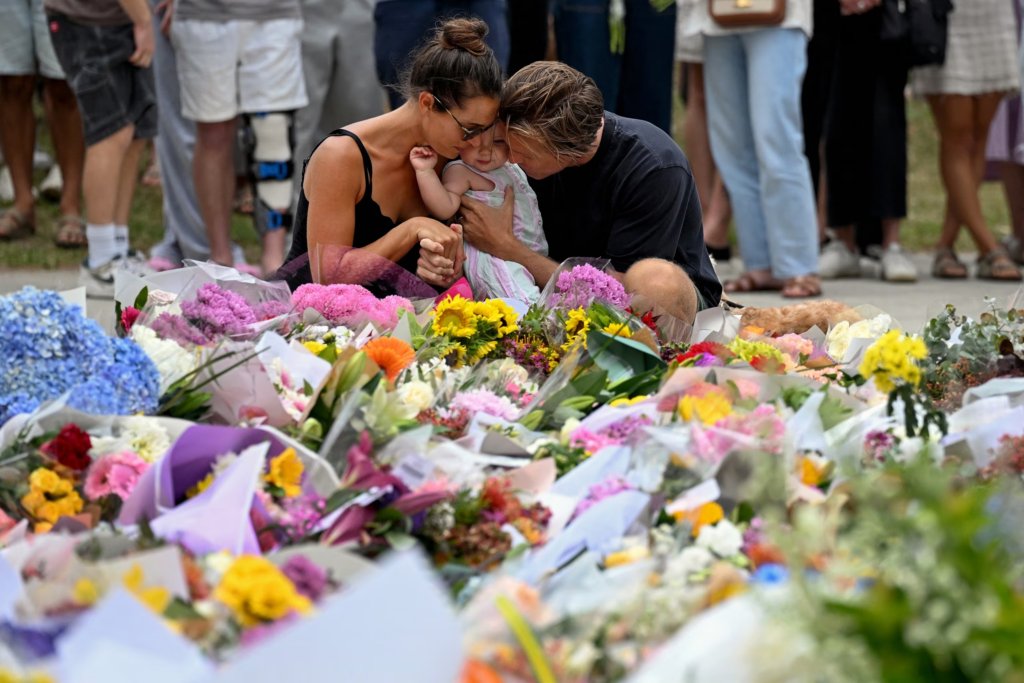
Matilda Britvan (10): Youngest victim, identified by aunt Lina Chernykh as “a happy kid” whose family “will never recover” from loss. Matilda won national literacy prize two days before her death and was excited about attending petting zoo at Hanukkah celebration. Her school tribute described her as “our little ray of sunshine” with “incredible gift to bring joy to those around her.” Funeral on December 18 drew hundreds of mourners bearing bright bouquets, with photographs showing Matilda’s beaming smile becoming focal point for Australia’s grief.
Alex Kleytman (87): Holocaust survivor who emigrated from Ukraine and worked as civil engineer for decades in Sydney. His wife Edith told reporters he was shot while shielding her from gunfire, dying instantly. “He survived Hitler only to be killed by terrorists in Australia. What has the world become?” Edith said from hospital where she was treated for injuries.
Rabbi Yaakov Levitan (39): South African-born rabbi serving as secretary of Sydney Beth Din (rabbinical court), Levitan was “deeply involved in Chabad operations.” Community members remembered him as “unassuming” and “an amazing father” to his children.
Boris Gurman (69) and Sofia Gurman (61): Russian-Jewish couple who made first heroic stand against terrorists, tackling Sajid Akram as he exited vehicle with rifle. Both were shot and killed before attack on main crowd began. Their actions delayed attackers by crucial 90 seconds, allowing some attendees to reach cover.
Dan Elkayam (27): French national working in Sydney as IT analyst for NBCUniversal and playing for Rockdale Ilinden FC soccer club. Club president described him as “extremely talented midfield player” and “down to earth, happy go lucky individual warmly embraced” by teammates.
Peter Meagher (61): Retired police detective with 40 years service, working as freelance photographer at Hanukkah event. Randwick DRUFC rugby club mourned loss of their manager, noting his dedication to community service continued through retirement.
Edith Brutman (68): Vice president of B’nai B’rith NSW anti-prejudice and anti-discrimination committee, her death carries “painful and profound significance” given life’s work fighting hatred. Survived by son and nephew.
Reuven Morrison (62): Soviet-born businessman who threw objects at older gunman before being shot and killed by Naveed. His final act of resistance demonstrated courage even without weapons.
Tibor Weitzen (78): Described by granddaughter as “sweet grandpa who loved life,” Weitzen’s family told media they are “shattered” and “have no words” for devastation.
Marika Pogány (82): Slovak citizen and close friend of former Slovak President Zuzana Čaputová, who first met her during visit to Auschwitz concentration camp. Pogány volunteered delivering meals to Jewish seniors.
Adam Smyth (50): Bondi local taking evening walk with wife when attack occurred. Non-Jewish Australian whose presence at public event demonstrates terrorists targeted location accessible to all residents.
Boris Tetleroyd (68): Visitor at Hanukkah event who died alongside wounded son Yakov, who survived and is recovering in hospital. Tetleroyd was primary provider for family, prompting niece to launch fundraiser for widow.
The diversity of victims — spanning ages 10 to 87, including Holocaust survivors, rabbis, IT workers, photographers, and ordinary residents — underscores terror’s indiscriminate nature and attack’s impact rippling through entire community beyond immediate Jewish population.
What’s Next? Anthony Albanese Government Response, Royal Commission Possibility & Community Healing
Five days after massacre, Australia grapples with overlapping questions about security failures, gun regulations, antisemitism response, and community resilience. Prime Minister Albanese’s government faces mounting pressure to demonstrate concrete action beyond rhetoric, with critics arguing years of ignored warnings about rising antisemitism enabled environment where terrorists felt empowered to commit brazen daytime attack on iconic location.
The New South Wales government established Bondi Beach Victim Recovery Payment providing $35,000 lump sum for primary victims (those physically injured by bullets/shrapnel) and up to $75,000 for family groups of deceased victims’ immediate relatives. Additionally, standard Victims Support Scheme offers counseling, immediate financial assistance up to $5,000, economic loss coverage up to $30,000, and funeral expenses up to $9,500. Combined support packages total approximately $2.8 million across all eligible recipients — though no financial compensation adequately addresses trauma of losing child, parent, or spouse to terrorism.
Blood donation centers reported unprecedented surge — 50,000 appointments booked Monday December 15 alone, more than double previous single-day record, with 1,300 first-time donors. Lifeblood spokesperson Cath Stone called response “overwhelming demonstration of Australian solidarity,” though cynics note blood donation enthusiasm typically fades within weeks as media attention shifts to new crises.
Political leaders across spectrum have called for potential Royal Commission investigating security failures enabling attack, focusing on key questions:
- Why wasn’t Sajid Akram’s gun license application flagged when his son Naveed was investigated for terrorism in 2019?
- Did police provide adequate security for advertised public Jewish event during period of elevated antisemitism?
- Should ASIO have maintained surveillance on Naveed beyond 2019 six-month investigation?
- Did intelligence agencies track the Akrams’ November Philippines trip or miss radicalization indicators?
However, Royal Commissions typically take 2-3 years to complete investigations and produce recommendations, meaning immediate reforms will need to proceed based on existing evidence rather than waiting for comprehensive review. Albanese signaled December 18 that hate crime legislation strengthening would occur “within months, not years,” suggesting government prioritizes rapid response over deliberative inquiry.
Sydney’s Jewish community held dawn swimming vigil on December 18, with hundreds forming circle on Bondi Beach sand observing minute’s silence before running into ocean — powerful image of resilience reclaiming space terrorists tried to steal. Rabbi Benjamin Elton told assembled mourners: “We don’t let terrorists win by living in fear. We win by living openly, proudly, and together. That’s what Hanukkah teaches — one small light defeats all darkness.”
Meanwhile, Ahmed al-Ahmed’s $1.4 million GoFundMe will enable his family to relocate if desired, though Ahmed has indicated preference to remain in Sydney, rebuild his shop, and continue participating in community life despite trauma and ongoing death threats. His consistent message — “Don’t let them divide us” — offers roadmap for national healing, though whether Australia can maintain unity amid polarized political environment remains uncertain.
Conclusion: The Bondi Beach massacre of December 14, 2025 shattered Australia’s post-1996 illusion that strict gun laws guarantee safety from mass shootings, revealing systemic gaps where terrorists exploit licensing loopholes, family connections go unscrutinized, and rising antisemitism festers until exploding into deadly violence. Sajid and Naveed Akram’s choice to target Hanukkah celebration — festival commemorating Jewish resistance against persecution — adds cruel irony to attack designed to terrorize community into silence. Yet Ahmed al-Ahmed’s extraordinary courage wrestling rifle from gunman, Boris and Sofia Gurman’s fatal attempt to stop attackers before reaching crowd, and Bondi lifeguards’ selfless rescue efforts using surfboards as stretchers all demonstrate that heroism and humanity persist even amid horror. Australia now confronts difficult choices: tighten gun laws further risking backlash from legitimate owners, expand surveillance of religious communities risking civil liberties, or accept some level of terrorism risk as price of free society. The 15 victims — from 10-year-old Matilda to 87-year-old Holocaust survivor Alex Kleytman — deserve better than political paralysis and empty platitudes. They deserve action preventing next attack, protection for vulnerable communities, and justice ensuring Naveed Akram spends rest of life in prison reflecting on 17 minutes of evil that destroyed dozens of families and traumatized entire nation.
Disclaimer: This analysis compiles publicly available information from government sources (NSW Government Bondi Beach Attack Response), law enforcement statements, verified news reports, and victim family statements for educational purposes documenting December 14, 2025 terrorist attack. All statistics, casualty figures, and timeline details reflect information confirmed as of December 19, 2025 and may be updated as investigations continue. Victim names and ages published here have been confirmed by authorities, family members, or community organizations; some families requested privacy and their loved ones’ full identities remain withheld per their wishes. This article aims to inform public understanding of attack details, systemic failures, and community response without sensationalizing tragedy or disrespecting victims’ memories. Donations to support victims’ families should be directed through verified official channels including GoFundMe campaigns confirmed by platform, NSW Government victim support programs, or established Jewish community organizations. Readers experiencing trauma from attack coverage can access crisis support through Lifeline (13 11 14), Beyond Blue (1300 22 4636), or NSW Mental Health Line (1800 011 511).