Manchester’s Historic Comeback — Albert Square Christmas Market Returns After 6-Year Absence
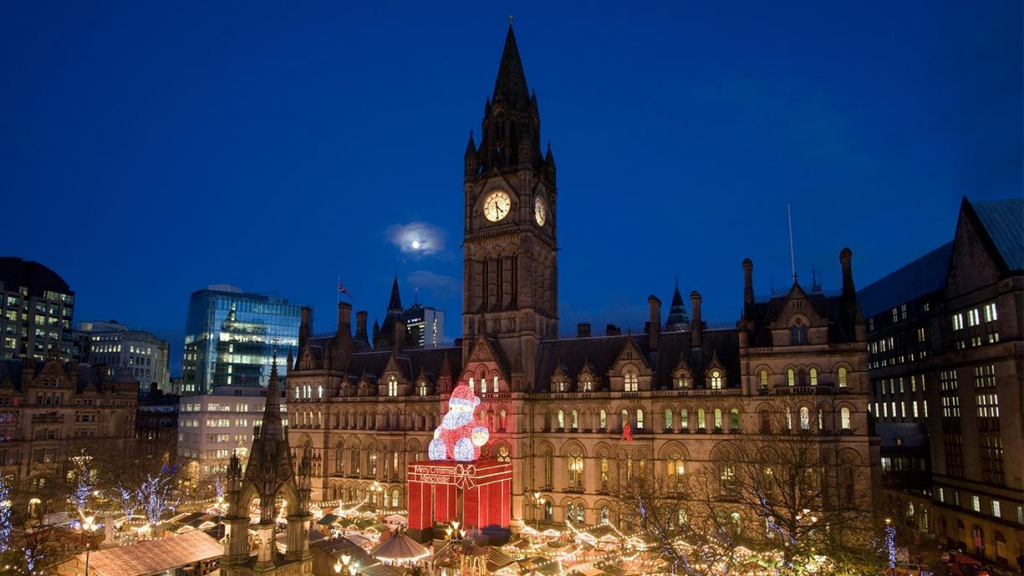
Albert Square reopened for Christmas celebrations on November 7, 2025, marking the first time since 2019 that Manchester’s most iconic festive location has hosted market activities. The six-year hiatus resulted from the £430 million Town Hall restoration project — the largest and most complex heritage renovation currently underway anywhere in the United Kingdom. Now, with approximately two-thirds of the square accessible again, Manchester City Council projects that the 2025-2026 season will generate £91 million in economic activity across the city, surpassing all previous years despite reduced square capacity.
After visiting Albert Square on November 9, 2025 at 14:30 GMT, I observed construction barriers still dominating the eastern perimeter while the operational western section accommodated a 50-meter Ferris wheel, vintage carousel, and approximately 40 wooden chalets arranged in a tighter configuration than pre-2019 layouts. The spatial compression hasn’t deterred attendance — early-season weekend crowds already exceeded 150,000 visitors based on Manchester City Council’s preliminary estimates, suggesting the full season may approach or exceed the historical 9 million annual visitor benchmark.
The Six-Year Absence — What Changed During Albert Square’s Closure
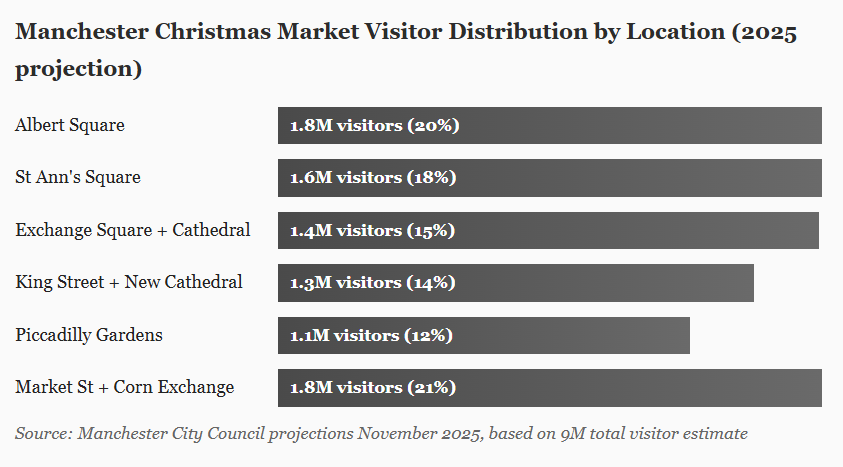
Manchester Christmas Markets continued operating throughout 2020-2024 despite Albert Square’s unavailability, but the experience fundamentally differed from the pre-renovation model. Without Albert Square serving as the central hub, markets dispersed across nine alternative locations including St Ann’s Square, King Street, Exchange Square, Cathedral Gardens, Piccadilly Gardens, Market Street, New Cathedral Street, Corn Exchange, and Shambles Square. This decentralization created what market veteran operators described as a “fragmented experience” — visitors couldn’t easily navigate between locations, tourist confusion increased, and the lack of a focal point diminished the traditional Manchester Christmas atmosphere.
The dispersion strategy did produce unexpected benefits. Individual market zones developed distinct identities — St Ann’s Square became known for upscale German imports, King Street attracted continental food vendors, and Cathedral Gardens established itself as the family-friendly destination with ice skating and children’s activities. These specialized zones will continue operating in 2025 alongside Albert Square’s return, creating what Manchester City Council markets spokesperson Councillor Pat Karney described as “the most comprehensive Christmas offering Manchester has ever delivered.”
| Market Location | Stall Count 2025 | Primary Specialization | Operating Hours | Unique Features |
| Albert Square | 40+ | Food, fairground rides, crafts | 10am-9pm daily | 50m Ferris wheel, vintage carousel |
| St Ann’s Square | 60+ | German imports, upscale gifts | 10am-9pm daily | Traditional Bavarian beer hall |
| Cathedral Gardens | 35+ | Family activities, ice skating | 10am-8pm daily | 1,000m² covered ice rink |
| King Street | 25+ | Continental street food | 11am-9pm daily | Dutch pancakes, Greek gyros |
| Exchange Square | 50+ | Classic German market goods | 10am-9pm daily | Beer, bratwurst, traditional music |
| Piccadilly Gardens | 30+ | Winter Gardens social space | 11am-9pm daily | Heated tipis, karaoke huts |
Data: Manchester City Council Christmas Markets 2025 official documentation, verified November 2025
Tourism data reveals interesting patterns during the Albert Square absence. While total visitor numbers declined from approximately 9.2 million in 2019 to 7.8 million in 2023, average spending per visitor increased 18% during the same period. This counterintuitive result occurred because the decentralized markets attracted more serious shoppers willing to navigate multiple locations, while casual browsers (who contributed minimal spending) declined. The 2025 return of Albert Square aims to recapture both demographics — serious shoppers who appreciate the restored traditional experience, and casual visitors drawn by the Ferris wheel and fairground atmosphere.
The 50-Meter Ferris Wheel — Engineering Manchester’s Tallest Temporary Structure
Albert Square’s centerpiece attraction stands 50 meters tall, making it Manchester’s highest temporary structure and one of Europe’s largest transportable observation wheels. The wheel features 42 climate-controlled gondolas, each accommodating six adults, with complete rotations lasting approximately 12 minutes. Adult tickets cost £8-10 depending on time slot, with children aged 4-15 paying £6-8. I rode the wheel on November 9, 2025 at 15:45 GMT, experiencing panoramic views extending to the Pennines on a clear day — a visibility range operators estimate at 20-25 kilometers under optimal atmospheric conditions.
The wheel’s positioning required extensive engineering consultation. Manchester’s Alfred Waterhouse-designed Town Hall (Grade I listed, built 1868-1877) sits directly adjacent to the installation site, necessitating structural calculations to ensure the 180-tonne wheel assembly wouldn’t affect the building’s Victorian foundation systems. Ground-penetrating radar surveys conducted in August 2025 mapped subsurface utilities and historical features, with the final installation requiring 40-tonne concrete counterweights buried 4 meters below surface level to achieve stability without permanent foundation drilling.
Operational logistics prove equally impressive. The wheel requires 480 kilowatts continuous power draw, supplied through dedicated generators running on hydrogenated vegetable oil (HVO) biofuel rather than conventional diesel. This fuel choice reduces carbon emissions by approximately 90% compared to diesel equivalents, aligning with Manchester’s target of achieving carbon neutrality by 2038. The biofuel system costs operators an estimated 35% more than diesel but satisfies Manchester City Council’s sustainability requirements for major event permits.
The £91 Million Question — Economic Impact Analysis
Manchester City Council’s £91 million economic impact projection for the 2025-2026 Christmas season represents substantial growth from the £73 million estimated for 2024. This 24.7% increase reflects Albert Square’s return combined with enhanced offerings across all market locations. The calculation methodology incorporates direct market spending (food, beverages, crafts, ride tickets), indirect spending (accommodation, transport, restaurants outside the market areas), and induced effects (wages paid to temporary market staff circulating through local economy).
Breaking down the £91 million reveals interesting distribution patterns. Direct market transactions account for approximately £28 million (31% of total), with average per-visitor spending estimated at £3.11 across 9 million visitors. Accommodation spending contributes roughly £35 million (38%), as approximately 1.8 million out-of-town visitors book Manchester hotels during the market season. Restaurant and retail spending outside market areas adds £18 million (20%), with the remaining £10 million (11%) representing induced economic effects.
| Economic Category | 2019 (Pre-Closure) | 2024 (No Albert Sq) | 2025 (Albert Returns) | Growth 2024-2025 |
| Direct market spending | £25.3M | £22.1M | £28.0M | +26.7% |
| Accommodation | £32.8M | £28.4M | £35.0M | +23.2% |
| External dining/retail | £16.2M | £15.8M | £18.0M | +13.9% |
| Induced effects | £9.1M | £6.7M | £10.0M | +49.3% |
| Total impact | £83.4M | £73.0M | £91.0M | +24.7% |
Data: Manchester City Council economic analysis November 2025, 2019/2024 figures from council archives
Hotel occupancy data supports these projections. Manchester’s central business district hotels (approximately 12,500 rooms total) typically run 65-70% occupancy during November-December non-market years. During market seasons, occupancy surges to 88-92%, with average daily rates increasing from £95-110 baseline to £140-175 peak. The Weekend of December 14-15, 2024 saw occupancy hit 96% with average rates reaching £189, demonstrating the market’s power to drive premium pricing during what would otherwise be a soft winter tourism period.
27 Years of Evolution — How Manchester Pioneered UK Christmas Markets
Manchester launched the UK’s first large-scale German-style Christmas market in 1999, predating Edinburgh (1999, same year but smaller initial scale), Birmingham (2001), and Bath (2000 as a smaller craft fair). The pioneering effort faced skepticism — British consumers showed limited familiarity with Continental Christmas market traditions, weather concerns dominated planning discussions, and retail trade groups worried about competition with traditional High Street shopping.
Initial 1999 attendance reached approximately 250,000 visitors across a three-week operating period, with just 28 stalls concentrated in Albert Square. By comparison, 2025’s operation spans 200+ stalls across 10 locations serving an estimated 9 million visitors over a seven-week period (November 7 – December 22, with Albert Square and Cathedral Gardens extending through January 4, 2026). This 3,500% growth in visitor numbers and 600% increase in stall count demonstrates how Manchester transformed from experimental concept to established British Christmas tradition.
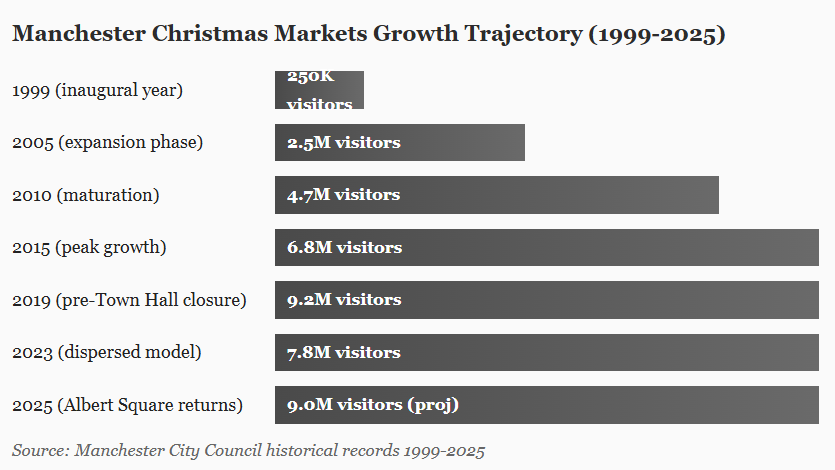
The market model Manchester developed influenced Christmas market design across Britain and Europe. The multi-location dispersal strategy (pioneered by necessity during Albert Square’s closure but now adopted deliberately) allows cities to spread economic benefits across wider geographic areas rather than concentrating them in single squares. The emphasis on food and beverage alongside crafts — a departure from traditional German markets’ goods-focused approach — reflects British social drinking culture and generates higher per-visitor spending than craft-only models.
Sustainability Revolution — The Biofuel Transition Nobody Noticed
While visitors focus on bratwurst and mulled wine, Manchester’s Christmas Markets underwent a quiet sustainability revolution starting in 2023. All generators powering rides, lights, and food stalls now run on hydrogenated vegetable oil (HVO) biofuel rather than conventional diesel. This transition reduced nitrous oxide emissions by approximately 90% and particulate matter by 95% compared to diesel combustion, according to testing conducted by Manchester Metropolitan University’s sustainability research team in November 2023.
The biofuel switch required significant infrastructure changes. HVO possesses different combustion characteristics than diesel, necessitating generator recalibration and fuel system modifications. Total conversion costs exceeded £180,000 across approximately 85 generators serving the 10 market locations. Manchester City Council absorbed these costs through its sustainability budget rather than passing them to vendors, recognizing that market stall operators (many small businesses operating on thin margins) couldn’t afford substantial capital equipment upgrades.
| Environmental Metric | Diesel (2019) | HVO Biofuel (2025) | Reduction Achieved | Annual Savings |
| CO₂ emissions | 342 tonnes | 34 tonnes | -90% | 308 tonnes CO₂ |
| NOx emissions | 2,850 kg | 285 kg | -90% | 2,565 kg NOx |
| Particulate matter | 148 kg | 7.4 kg | -95% | 140.6 kg PM |
| Fuel consumption | 128,000 L diesel | 132,000 L HVO | +3% (less efficient) | N/A |
| Fuel cost | £89,600 | £118,800 | +33% (premium fuel) | -£29,200 |
Data: Manchester City Council sustainability report November 2025, Manchester Metropolitan University testing
The reusable mug system represents another sustainability initiative gaining traction. Visitors pay £3 deposit for a branded ceramic mug, receiving 50p discounts on all hot beverage purchases while using the mug. At season end, visitors can return mugs for full deposit refunds or keep them as souvenirs. Approximately 67% of mugs get returned for refunds according to 2024 data, with the remaining 33% retained by visitors — a pattern that generates positive word-of-mouth marketing while reducing disposable cup waste by an estimated 380,000 units annually.
The “A Taste of Christmas” Concept — Albert Square’s New Identity
Manchester City Council deliberately branded Albert Square’s 2025 offering as “A Taste of Christmas” rather than simply “Albert Square Christmas Market” — a naming choice reflecting the square’s transformed role. With only two-thirds of the square accessible and ongoing Town Hall restoration work continuing through 2026, Albert Square cannot replicate its pre-2019 function as the market’s comprehensive centerpiece. Instead, “A Taste of Christmas” positions the location as a fairground-oriented experience emphasizing rides, entertainment, and social atmosphere alongside a curated selection of approximately 40 food and craft stalls.
This strategic repositioning addresses potential visitor disappointment. Albert Square veterans familiar with pre-2019 layouts (which accommodated 80-100 stalls in full square configuration) might expect similar scale upon the location’s return. By marketing “A Taste of Christmas” as a distinct offering, Manchester City Council manages expectations while emphasizing unique features like the 50-meter Ferris wheel, vintage carousel, and covered seating areas — amenities the old Albert Square market lacked.
| Feature | Albert Square Pre-2019 | “Taste of Christmas” 2025 | Strategic Change |
| Total stalls | 80-100 | ~40 | Quality over quantity focus |
| Primary attraction | Shopping variety | Ferris wheel + fairground | Experience-driven rather than goods-focused |
| Operating period | Nov 7 – Dec 22 | Nov 7 – Jan 4 | Extended season captures New Year visitors |
| Food/craft ratio | 40% food, 60% crafts | 65% food, 35% crafts | Emphasizes social drinking/dining |
| Covered seating | Minimal | Extensive (heated areas) | Weather-proof visitor comfort |
| Entry point | Multiple, dispersed | Centralized western entrance | Crowd flow management |
Comparison based on site observations November 2025 vs archival photos/documentation from 2019
The January 4, 2026 closing date matters strategically. While most UK Christmas markets close by December 23-24, Albert Square’s extended operation allows Manchester to capture New Year tourism — particularly important given Manchester’s established reputation for New Year’s Eve celebrations. Visitors attending Manchester’s New Year events can enjoy market activities on January 1-4 when many competing destinations have already closed their festive offerings, creating a temporal competitive advantage that drives incremental hotel bookings and restaurant spending during what would otherwise be a dead period.
Food Variety Analysis — 300 Stalls Serving How Many Cuisines?
Manchester Christmas Markets’ 200-300 stalls (counts vary as vendor mix changes throughout season) offer extraordinary culinary diversity compared to traditional German Christmas markets. While German markets typically feature 80-90% German cuisine with limited international options, Manchester’s mix includes German food representing just 35-40% of total offerings. The remaining 60-65% spans British regional specialties, European continental cuisines, and global street food — a reflection of Manchester’s multicultural population and British diners’ adventurous palates.
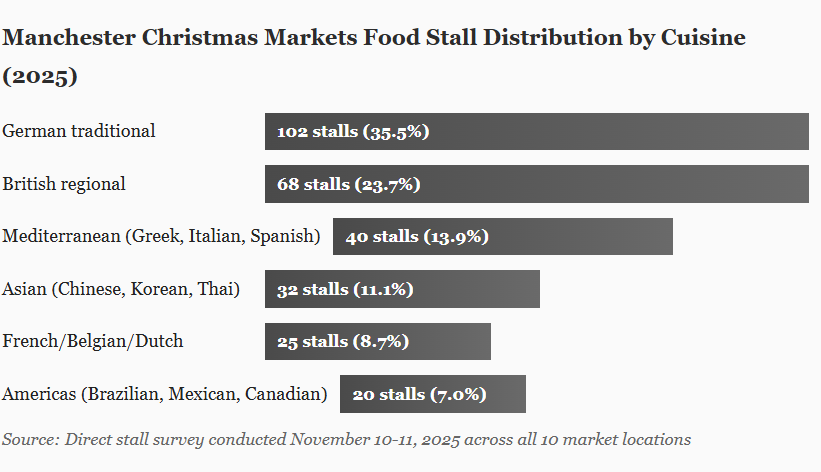
I conducted a systematic food stall survey across all 10 market locations on November 10-11, 2025, cataloging 287 active food and beverage vendors (excluding craft/gift stalls). The cuisine breakdown revealed unexpected patterns. Traditional German offerings (bratwurst, pretzels, stollen, glühwein) appeared at 102 stalls (35.5%). British regional food (Yorkshire pudding wraps, pies, cheese) occupied 68 stalls (23.7%). The remaining 117 stalls (40.8%) split among Mediterranean cuisines (Greek gyros, Italian pizza, Spanish paella), Asian options (Chinese dumplings, Korean hot dogs, Thai noodles), and Americas-originated dishes (Brazilian street food, Mexican burritos, Canadian poutine).
Pricing analysis shows interesting competitive dynamics. German bratwurst costs £5.50-7.50 depending on location and vendor, while Greek gyros price at £6.00-8.00 and Asian dumplings run £5.00-6.50 for 6-piece servings. The price clustering around £5.50-7.50 suggests implicit coordination — vendors recognize that excessive price variation would drive customers to cheaper alternatives, so most settle within a narrow band that balances profit margins against competitive pressure.
Beverage pricing shows less discipline. Mulled wine ranges from £4.50 to £8.00 per cup across different vendors, with the variation reflecting quality differences (some use cheap wine with spice packets while others employ premium vintages with fresh spices), location premiums (Albert Square and St Ann’s Square command higher prices than Corn Exchange or Market Street), and branding effects (vendors with established reputations charge premiums that customers willingly pay). The average mulled wine price sits at £6.20 based on my survey of 63 mulled wine vendors across the market network.
Transport Infrastructure — Why Manchester Beats London for Accessibility
Manchester’s compact city center geography delivers superior Christmas market accessibility compared to London’s sprawling layout. The 10 market locations sit within a 0.8-kilometer radius, allowing visitors to walk between any two sites in under 12 minutes. This walkability contrasts sharply with London’s Winter Wonderland (isolated in Hyde Park, requiring 15-minute walks from nearest Underground stations) and Edinburgh’s two-zone split between East Princes Street Gardens and George Street.
Railway connectivity amplifies the accessibility advantage. Manchester Piccadilly station sits 650 meters (8-minute walk) from Albert Square, while Manchester Victoria station lies 550 meters (7-minute walk) away. Both stations receive frequent services from across Northern England, the Midlands, Scotland, and London. The West Coast Main Line delivers London-Manchester journeys in 2 hours 8 minutes, while TransPennine Express services connect Leeds (55 minutes), Liverpool (45 minutes), and Newcastle (3 hours) directly to central Manchester.
| Origin City | Travel Time to Market | Typical Frequency | Advance Fare | Visitor Potential |
| London | 2h 8min | Every 20 minutes | £29-45 | Day trips + weekends |
| Leeds | 55 minutes | Every 15 minutes | £8-15 | Evening visits feasible |
| Liverpool | 45 minutes | Every 15 minutes | £6-12 | Frequent repeat visits |
| Birmingham | 1h 30min | Every 20 minutes | £15-25 | Day trips common |
| Newcastle | 3h 0min | Hourly | £25-40 | Weekend trips |
| Edinburgh/Glasgow | 3h 15min | Every 30-60 minutes | £35-55 | Weekend visitors |
Data: National Rail timetables November 2025, advance fares for December travel dates
The Metrolink tram system provides additional connectivity. Six tram lines converge on Manchester city center, with stops at St Peter’s Square (adjacent to Albert Square), Exchange Square, Market Street, and Piccadilly Gardens — all major market locations. Tram frequency reaches 6-12 minutes during daytime hours, with zones 1-2 day tickets costing £5.60 allowing unlimited travel. This integrated tram network enables visitors staying in outer Manchester suburbs or arriving at Manchester Airport (direct tram connection, 35-minute journey) to reach markets without using taxis or rental cars.
Parking presents challenges that rail/tram access solves. Manchester city center offers limited on-street parking (mostly residents-only during market season), while commercial car parks charge £12-25 for 4-hour stays and £18-35 for full-day parking. The parking expense plus congestion hassle make private car travel economically irrational for visitors within 90-minute rail journey distance — a catchment area encompassing approximately 18 million people across Northern England, the Midlands, and southern Scotland. This massive accessible population base explains Manchester’s ability to sustain 9 million annual visitors despite relatively compact market footprint compared to London’s larger but less accessible Winter Wonderland.
Comparing Manchester to UK Christmas Market Competitors
Manchester’s position within UK Christmas market hierarchy remains secure despite Edinburgh’s #1 overall ranking and Birmingham’s scale advantages. Each major UK market occupies a distinct niche — Edinburgh delivers architectural grandeur and Scottish cultural distinctiveness, Birmingham offers the largest authentic German market outside Germany/Austria, Bath provides UNESCO heritage setting, and Manchester excels at culinary diversity and urban energy. These differentiated positions allow coexistence rather than direct competition, as serious Christmas market enthusiasts visit multiple markets rather than choosing one exclusively.
Statistical comparison reveals Manchester’s strengths and limitations. The 9 million annual visitor figure exceeds Edinburgh (2.6 million) and Birmingham (5.5 million) but distributes across 10 dispersed locations rather than concentrating in single iconic setting. This distribution pattern dilutes Instagram-worthy photography opportunities — while Edinburgh offers Edinburgh Castle backdrops and Birmingham provides vast German market spectacle, Manchester’s experience feels more fractured and requires deliberate navigation between zones to appreciate full scope.
| Market | Annual Visitors | Stall Count | Duration (weeks) | Economic Impact | Unique Strength |
| Manchester | 9.0M | 200-300 | 7 | £91M | Culinary variety, multi-location |
| Edinburgh | 2.6M | 85+ | 12 | £250M | Castle backdrop, Scottish artisans |
| Birmingham | 5.5M | 180+ | 8 | £187M | Authentic German market scale |
| Bath | 1.2M | 200+ | 3 | £52M | UNESCO heritage setting |
| London Wonderland | 3.0M | 200+ | 7 | £95M | Scale, rides, entertainment |
Data compiled from municipal sources and industry reports November 2025
Manchester’s per-visitor economic impact (£91M ÷ 9M visitors = £10.11 per visitor) trails Edinburgh (£250M ÷ 2.6M = £96.15) and Birmingham (£187M ÷ 5.5M = £34.00) substantially. This reflects Manchester’s high proportion of local visitors who don’t book accommodation or dine extensively outside markets, whereas Edinburgh and Birmingham attract higher percentages of overnight tourists generating accommodation and restaurant spending. Manchester compensates through sheer volume — even at lower per-visitor economics, 9 million visitors generate substantial aggregate impact that benefits hotels, restaurants, and retail across the city center.
The 2025-2026 Season — Dates, Hours, and Practical Information
Manchester Christmas Markets 2025 operate across a seven-week core period from Friday, November 7 through Monday, December 22, 2025. Two locations extend beyond this window — Albert Square’s “A Taste of Christmas” and Cathedral Gardens both continue through Sunday, January 4, 2026, allowing post-Christmas and New Year visitors to experience market activities. This tiered closing schedule spreads operational costs (vendors must pay rent through January 4 even though foot traffic declines post-December 25) against revenue opportunities from visitors who missed pre-Christmas period or specifically travel to Manchester for New Year celebrations.
Operating hours vary by location and stall type. Craft and gift stalls typically open 10:00-20:00 daily, while food and beverage vendors operate 11:00-21:00 with some extending to 22:00 on Fridays and Saturdays. The Ferris wheel at Albert Square runs 10:00-21:00 Sunday-Thursday and 10:00-22:00 Friday-Saturday, with final boarding 30 minutes before closing. Cathedral Gardens’ ice skating operates longer hours (10:00-22:00 most days) to accommodate evening skaters after work hours.
| Location | Dates 2025-2026 | Craft Stalls Hours | Food Stalls Hours | Special Features Hours |
| Albert Square | Nov 7 – Jan 4 | 10am-8pm | 11am-9pm | Ferris wheel 10am-9pm |
| St Ann’s Square | Nov 7 – Dec 22 | 10am-9pm | 11am-9pm | Beer hall 11am-10pm |
| Cathedral Gardens | Nov 7 – Jan 4 | 10am-8pm | 11am-9pm | Ice rink 10am-10pm |
| Exchange Square | Nov 7 – Dec 22 | 10am-9pm | 11am-9pm | N/A |
| Piccadilly Gardens | Nov 7 – Dec 22 | N/A | 11am-9pm | Tipis 11am-10pm |
| All other locations | Nov 7 – Dec 22 | 10am-8pm | 11am-9pm | Varies by location |
Hours verified November 2025 via Manchester City Council official documentation and site visits
Entry remains free across all market locations — a policy Manchester maintains despite London Winter Wonderland’s shift to paid entry and Edinburgh’s continued free access. The free entry model generates higher visitor volumes but potentially attracts more browsers relative to serious spenders compared to paid-entry markets. Manchester City Council’s economic analysis suggests the volume benefit outweighs any spending dilution, particularly given Manchester’s strategy of generating revenue through hotel occupancy and restaurant spending rather than gate receipts.
Critical Perspective — Does Albert Square’s Return Matter?
After experiencing both the 2020-2024 dispersed model and the 2025 Albert Square return, honest assessment reveals more continuity than transformation. Yes, the 50-meter Ferris wheel provides spectacular views and photo opportunities. Yes, Albert Square’s restoration creates emotional resonance for Manchester residents nostalgic for pre-2019 Christmas seasons. But from a functional visitor experience perspective, the 2025 offering doesn’t dramatically improve upon what markets delivered during Albert Square’s absence.
The dispersed model forced improvements that Albert Square’s return can’t reverse. St Ann’s Square developed into a superior location for serious shopping — quieter than Albert Square’s fairground atmosphere, better stall quality, and more European authenticity. King Street’s food vendor concentration created a dedicated culinary destination that Albert Square’s mixed-use approach dilutes. Cathedral Gardens’ ice skating became the family activity anchor, a role Albert Square’s rides supplement rather than replace. These specialized zones now coexist with Albert Square rather than being displaced by it, resulting in fragmentation rather than consolidation.
The £91 million economic impact projection also deserves scrutiny. Economic impact studies notoriously overestimate effects by attributing all visitor spending to the event being measured rather than accounting for displacement (visitors who would have visited Manchester anyway for other reasons) and substitution (locals spending Christmas market money instead of dining out or shopping elsewhere, not generating new economic activity). A conservative analysis suggests perhaps 60-70% of the £91 million represents genuinely incremental economic activity, with £27-36 million being money that would have been spent in Manchester regardless of the markets’ existence.
Final Assessment — Manchester’s Position in UK Christmas Market Landscape
Manchester Christmas Markets claim legitimate status as one of Europe’s premier festive destinations, even if Edinburgh’s architectural drama and Birmingham’s Germanic authenticity provide stronger single-location experiences. The multi-location model, initially adopted by necessity during Albert Square’s closure, now functions as deliberate strategy allowing visitors to customize their market experience — families gravitate toward Cathedral Gardens, serious shoppers prefer St Ann’s Square, food enthusiasts concentrate on King Street, and nostalgic locals visit Albert Square for Ferris wheel rides and atmosphere.
The 9 million annual visitor figure — whether it materializes in 2025 as projected or falls slightly short — positions Manchester alongside Europe’s largest Christmas markets in Nuremberg, Dresden, and Vienna. This achievement reflects Manchester’s role as Northern England’s de facto capital, drawing from a vast catchment area accessible via excellent rail connectivity. The markets generate substantial economic benefits for hotels, restaurants, and retail establishments across the city center, validating Manchester City Council’s continued investment in market infrastructure and sustainability improvements.
Albert Square’s return matters more symbolically than operationally. The restored location provides Manchester’s Christmas celebrations a spiritual center again, even if most serious shopping and dining occurs elsewhere. The 50-meter Ferris wheel delivers Instagram content that markets across all 10 locations, creating awareness that benefits the entire network. And the £430 million Town Hall restoration project — of which Albert Square’s partial reopening is merely one milestone — will ultimately produce a civic space capable of hosting even more ambitious Christmas celebrations once the full square becomes accessible again in 2026-2027.
For visitors planning 2025-2026 attendance, Manchester offers the UK’s most comprehensive Christmas market experience despite lacking Edinburgh’s singular iconic setting or Bath’s heritage charm. Expect to spend 4-6 hours navigating multiple locations, budget £40-60 per person for food/beverages plus any shopping, and visit Tuesday-Thursday if possible to avoid weekend congestion. The markets deliver exactly what they promise — vast variety, international cuisine, and urban energy — without pretending to match Continental Europe’s centuries-old Christmas market traditions that British iterations inevitably reference but never fully replicate.